Why the System Doesn’t Move
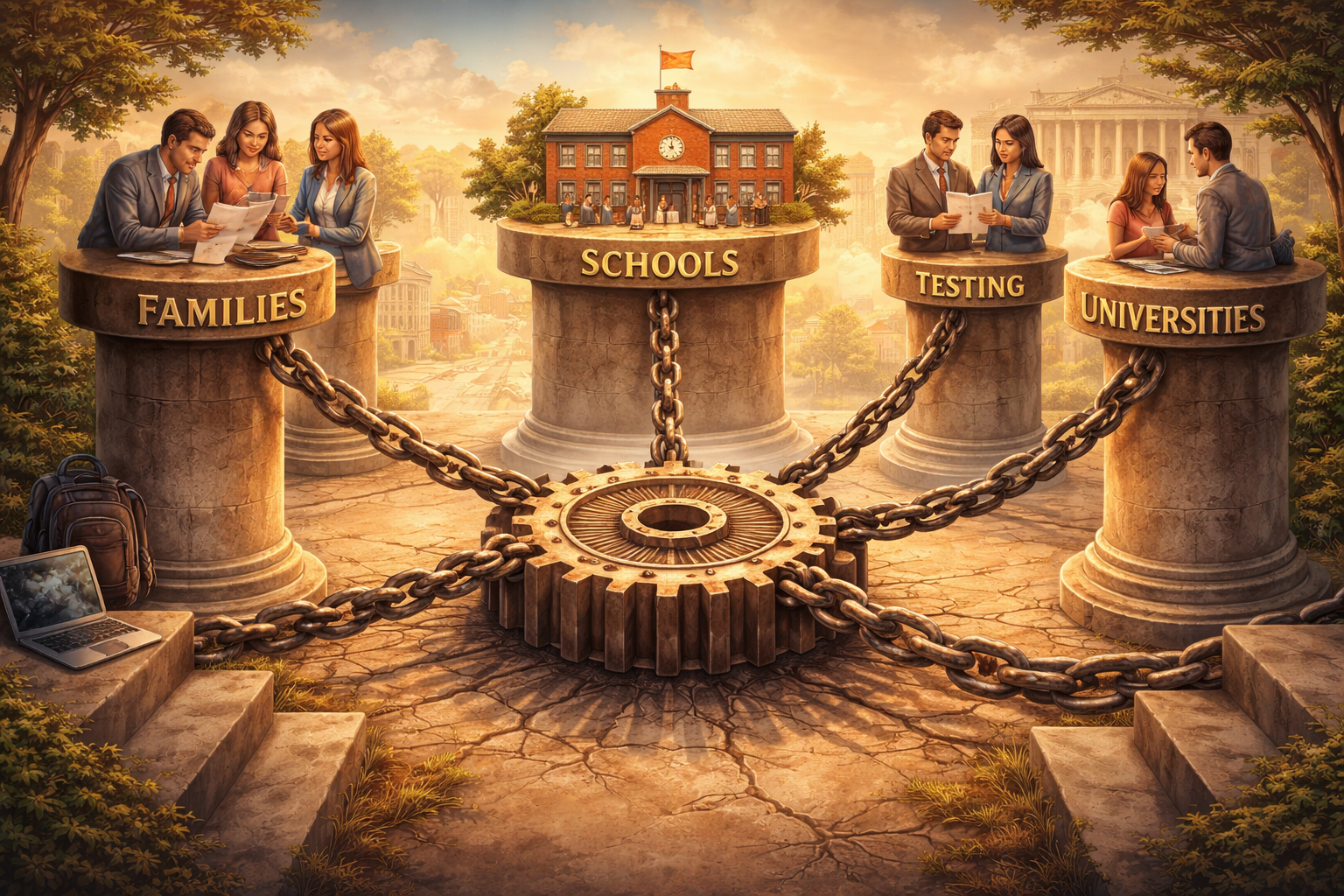
Education is not slow to change because it lacks ideas.
It is slow because schools, universities, families, testing systems, and other institutions are tied to one another in ways that make meaningful movement difficult to coordinate.
If the path forward for learning and assessment is becoming clearer, another question follows:
Why isn’t the system changing more quickly?
Part of the answer sits in the structure itself.
Education is often discussed as though it were one system. In practice, it is a network of institutions, each responding to the expectations, incentives, and constraints of the others.
K–12 schools prepare students for university. Universities rely on signals from K–12 to make decisions at scale. Families make choices around those pathways. Testing organizations and curriculum providers create common measures that allow people operating across different contexts to compare outcomes.
Each part helps stabilize the others.
That stability has value. It also makes movement difficult.
K–12 schools offer a clear example.
Many have been experimenting with more active, discussion-based, interdisciplinary, and project-driven approaches to learning. These environments can create more room for communication, collaboration, judgment, and independent thought.
Yet those same schools still operate inside university admissions systems that depend heavily on grades, test scores, transcripts, and other standardized signals.
So schools can change what learning looks like without fully changing what success must eventually look like.
Move too far from established signals, and uncertainty increases for students and families. Stay too closely aligned with them, and the room for deeper change narrows.
Universities face a different version of the same problem.
They operate at a scale that requires comparison across thousands of applicants from different schools, countries, curricula, and educational systems. Standardized signals make that possible.
Those signals may be incomplete, but they are legible.
Replacing them requires more than recognizing their limitations. It requires another way to make complex decisions consistently, fairly, and at scale.
Families reinforce the structure in another way.
Many parents experienced success within the existing system. Grades, credentials, recognizable universities, and familiar pathways carry a history of reliability. New models may be intellectually compelling while still feeling riskier when a child’s future is attached to them.
Schools feel that caution.
So do universities.
Around all of this sit organizations whose work depends on shared benchmarks and common structures. Testing bodies, curriculum providers, accreditation systems, and other institutions help make education portable and comparable across borders.
Their presence is not evidence of resistance.
It reflects how much of the system has been built around coordination, predictability, and trust.
The difficulty is that the conditions underneath that arrangement are beginning to shift.
AI expands access to information. It changes how work can be produced. It complicates assumptions about authorship. It makes some traditional forms of assessment less reliable while opening new possibilities for inquiry, feedback, and collaboration.
Learning can change quickly.
The systems that recognize, credential, and compare learning usually cannot.
That creates an increasingly visible gap between what students are able to do, how they are learning, and the signals institutions still use to interpret that learning.
Closing that gap is not simply a matter of better classroom practice or more progressive policy.
It requires movement across institutions that operate on different timelines and answer to different constituencies.
That is why the system can appear still even while individual parts of it are changing.
Schools experiment.
Universities adjust.
Families reconsider.
Employers begin valuing different signals.
Students develop new expectations.
None of those shifts happens in isolation, and none is enough on its own.
The system moves when enough of those pressures begin reinforcing one another rather than pulling in different directions.
The more useful question, then, may not be why education is refusing to change.
It may be how long its current forms of coordination can continue to hold as the conditions beneath them keep changing.
by Carl E. Murray
Founder, Erlazion
[About Carl]