AI in Education

Build the culture around AI before the habits build themselves.
AI adoption in schools is not primarily a technology challenge.
It is a cultural and developmental one.
Students are already forming habits around when they turn to AI, what they hand over, how long they remain with uncertainty, and which parts of the thinking process still feel like their responsibility.
Those patterns develop through repeated use long before they appear in policy documents or strategic plans.
Erlazion helps schools shape those patterns intentionally by building healthy norms, developmental expectations, and shared institutional practice around AI.
AI Is a Learning and Culture Question
Most school conversations about AI begin with tools, acceptable use, assessment, productivity, or policy.
Those questions matter, but they are downstream.
The deeper issue is what repeated AI use is teaching students to expect from themselves, from technology, and from the learning process.
Schools therefore need more than rules about when AI is allowed. They need a shared understanding of what healthy use looks like, what cognitive responsibility should remain with the learner, how expectations should change as students develop, and what kinds of habits the institution wants to normalize.
That is the lens Erlazion brings to the work.
Three Dimensions of Healthy AI Adoption
Healthy AI adoption requires more than access to tools or a set of rules. It depends on the habits students develop, the responsibilities they continue to carry, and the degree to which the institution creates shared expectations around use.
Healthy AI Habits
Shape the patterns before they become defaults.
Students are already forming habits around when they turn to AI, what they ask it to do, how quickly they seek assistance, and how much of the thinking process they continue to carry themselves.
Those habits matter because repeated use gradually establishes expectations about effort, uncertainty, authorship, and problem-solving.
Erlazion helps schools make those patterns visible and shape them intentionally so AI extends learning without quietly becoming the default response to every challenge.
This work may include:
- student AI-use habits and interaction patterns
- cognitive offloading and dependency risks
- healthy norms for when and how AI enters the learning process
- reflection, judgment, and intentional use
- authorship and ownership of thinking
- classroom expectations that preserve meaningful cognitive responsibility
Developmental Responsibility
AI support should change as student judgment develops.
The same level of AI support is not appropriate for every learner, task, or stage of development.
As students gain knowledge, judgment, and independence, schools need clear expectations around what they should continue to do themselves, where AI can appropriately support the work, and how responsibility should shift over time.
Erlazion helps schools establish developmental expectations around AI use so students are not simply taught what is permitted, but how to make increasingly thoughtful decisions about when and why to use it.
This work may include:
- age- and stage-appropriate AI expectations
- authorship and cognitive responsibility
- productive uncertainty and reflective friction
- developmental progression in AI use
- teacher judgment around appropriate support
- preserving student agency as AI capability increases
Institutional Alignment
Healthy AI use cannot depend on individual classrooms making the rules alone.
When every teacher, department, or division develops its own assumptions about AI, students experience inconsistent expectations and schools struggle to build a coherent culture.
Institutional alignment creates shared language around what healthy use looks like, what the school is trying to protect, where flexibility is appropriate, and how expectations connect across leadership, teaching, assessment, and student practice.
Erlazion helps schools move from isolated experimentation toward a more intentional institutional posture around AI.
This work may include:
- shared language and institutional norms
- leadership and faculty alignment
- policy and practice coherence
- classroom and assessment expectations
- communication with students and families
- implementation across departments and divisions
- institutional posture toward evolving AI capability
When to Bring Erlazion In
AI challenges in schools rarely appear as a single problem.
Sometimes the issue is policy. Sometimes faculty are experimenting in very different ways. Sometimes students are already using AI extensively, but the institution has not yet established shared expectations. Sometimes leaders know AI is changing learning but are unsure what should remain constant.
Erlazion can be most useful when a school is navigating moments such as:
- developing or revising an institutional approach to AI
- moving beyond an acceptable-use policy toward shared practice
- inconsistent expectations across teachers, departments, or divisions
- uncertainty about what healthy student AI use should look like
- concern about cognitive offloading, dependency, or authorship
- questions about how AI should affect assessment and academic integrity
- faculty uncertainty about when AI should support learning and when students should carry the work themselves
- a need for age- or stage-appropriate expectations across grade levels
- leadership teams trying to align policy, classroom practice, and school culture
- parent or community questions about how the school is responding to AI
- a desire to introduce AI thoughtfully without allowing the technology itself to define the direction
The common thread is not simply whether a school is using AI. It is whether the institution is shaping how that use develops.
From Exploration to Institutional Practice
Schools enter this work from different places. Some are beginning to build shared language around AI. Others want to test the ideas with students and educators before committing to broader implementation. Some are ready for a more coherent institutional framework.
Erlazion provides several ways into the work.
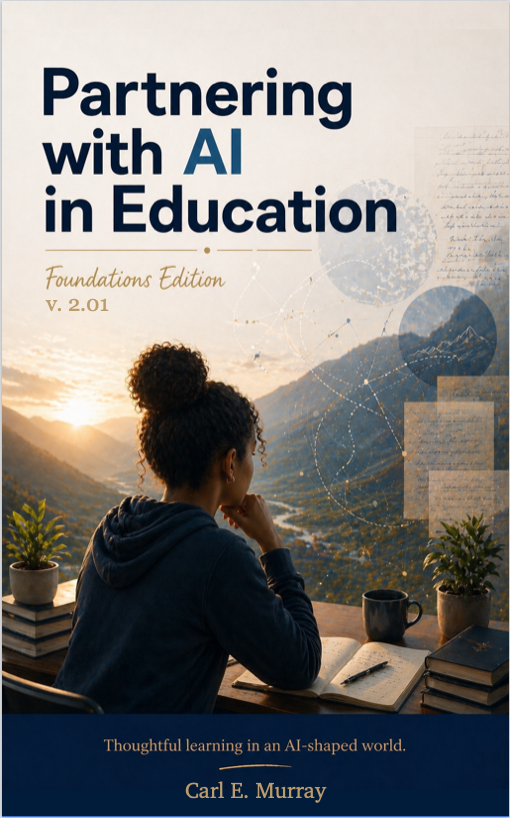
Start with the Foundations
An accessible introduction for educators, students, families, and school communities beginning to think more intentionally about AI use.

Experience the Framework
Four-Week Institutional Pilot
A contained way for a school to experience the opening sequence of Agentic Partnership in Education, observe student and educator practice, and develop a stronger basis for deciding what should come next.

Adopt Institutionally
Agentic Partnership in Education
A comprehensive institutional framework for schools seeking shared language, developmental expectations, educator guidance, and coherent practice around AI.
What an Engagement Can Look Like.
Every school enters AI adoption from a different place.
Some need help establishing shared direction. Others need support translating an existing policy into classroom practice. Some are ready for faculty development, student-facing work, or a broader institutional framework.
Erlazion’s role can range from focused advisory support to deeper implementation work, depending on the institution’s needs and stage of adoption.
Engagements may include:
- Leadership Advisory - Thought partnership with Heads of School, academic leaders, technology leaders, or AI working groups as they make decisions about institutional posture, policy, expectations, and implementation.
- Faculty Learning & Facilitation - Workshops and facilitated sessions that help educators examine healthy AI use, developmental responsibility, authorship, judgment, assessment, and the role AI should play in learning.
- Institutional Framework Development - Support in building shared language, developmental expectations, policy alignment, and practical guidance that can work across divisions, departments, and age groups.
- Student & Community Learning - Structured sessions with students, families, or broader school communities designed to build shared understanding around healthy habits, responsibility, and intentional AI use.
- Implementation Support - Continued support as new expectations move into classrooms, assessment, communication, leadership practice, and the everyday routines that ultimately shape school culture.
The form of the engagement depends on where the school is starting. The goal is the same: move AI from a collection of individual decisions toward a coherent institutional culture.
Start a Conversation
If your school is working through AI policy, faculty practice, student use, assessment, or a broader question about what healthy adoption should look like, tell me what you’re navigating.
I’ll respond personally to arrange a time to talk.
Thank you for getting in touch!
One of our colleagues will get back to you shortly.
Have a great day!